Photo credit: Wikimedia Commons Terrabass
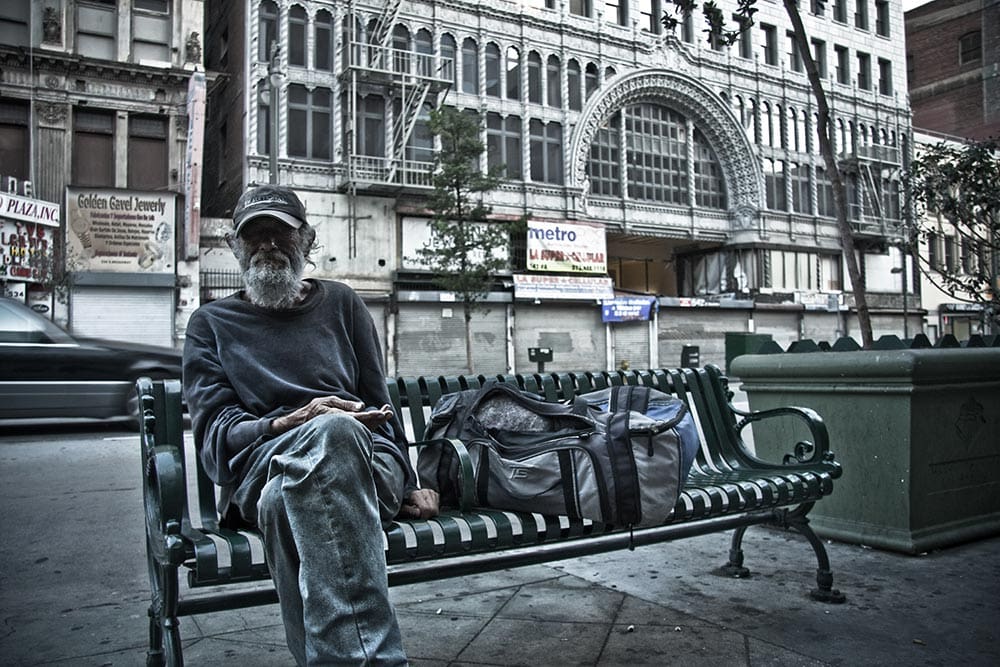
Go for a walk through any British city centre. Public sitting areas, be it benches or the edge of a water fountain, are being subjected to a silent redesign that is filtering out those without a roof on their head.
According to the Single Homeless Project, this is hostile architecture: the deliberate, cruel shaping of public spaces to stop people from resting, sleeping, or simply existing. Examples include: concrete studs embedded in pavements, heavy metal bars dividing public benches, iron railings blocking underpasses, and sloped seating engineered to prevent rest.
In 2025, the Labour government promised to decriminalise rough sleeping after 200 years but delays have led to the issue’s loss of importance in public discourse. As the law moves away from criminalizing poverty, physical architecture is stepping in to enforce the very punishments the legal system left behind.
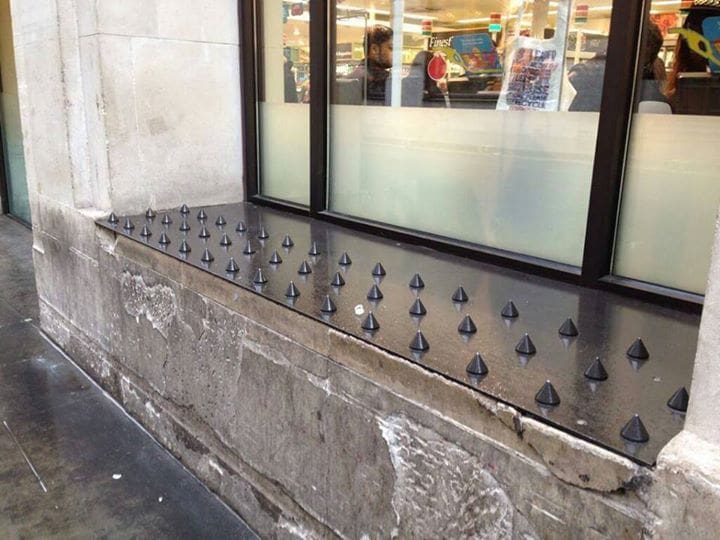
Spikes are a common method to prevent people resting in public spaces. Credit: Kent Williams
To unpack these hidden forces, Uproute sat down with Professor Aidan H. While, Professor of Urban Planning in the School of Geography and Planning at the University of Sheffield. He exposes how defensive design has become a thoughtless industry standard, why a park’s affluent location changes how it’s policed, and why the ultimate goal of hostile architecture is simply to spare the public from having to confront systemic societal collapse.
Q. Hi Professor While, could you tell us about your research interests at Sheffield university?
Aidan While: “I’m at the university because I’m interested in really understanding the politics of planning, how we regulate the built environment, how decisions are made around development, who has planning control and the management of public space. I’m also interested in how we make things hostile that shouldn’t be hostile, such as public spaces, benches, spaces of congregation, and the public realm.”
Q. If you had to describe hostile architecture or anti-homeless architecture in your own words, what would it be?
“It is development that really is designed to make it difficult for people to spend any length of time around buildings or public space. Particularly in terms of homelessness, it makes it difficult for people to lie down and makes it uncomfortable to sit there for a very long time. It makes it easier to exclude people who are unwanted from being in and around buildings or in and around public space. Hostile design is not a very explicit form of exclusion; it’s about the subtle things.”

Professor While’s research and teaching combines interests in environmental and climate policy, urban technology and future cities and the politics of planning in the UK and internationally.
Q. Developers or councils often excuse these as a design trend. But would you say it’s a deliberate strategy to keep loitering away?
“I think they become embedded in practice. It’s paralleled in interesting ways by architectures of security – the ways in which fears of terrorism have led to defensive architectures coming in as well. You have that parallel where defensive architecture becomes accepted as the mainstream. So even though it might not be conscious; it becomes embedded in practice – if you’re going to design a bench, the standard practice is to design it in a way that discourages people from lying down on it. It becomes presented as a common-sense, sensible approach to design.
Q. Who do you think is being pushed out in terms of groups of people because of these designs?
“I think there’s been an issue with the congregation of groups generally. Public space has got an interesting paradox where you want public spaces to feel busy and full, but you don’t want the perception that they might be threatening because of the ways in which people might dominate space. So I think it’s generally against congregation – the grouping together – which is about young people as much as the homeless. In a very tightly controlled built environment, we find less spaces of congregation in the city centre and more of them in parks and other spaces.”
Q. Beyond rough sleepers, how can unaccommodating or hostile architecture impact ordinary people on a day-to-day basis, like the elderly or disabled?
I don’t think ordinary people feel it particularly, because the balance in urban design is around making sure spaces are accessible. We could always do more on creating spaces which are more comfortable for families or disabled people, but I don’t think they’ll experience hostile architecture in the same way because the logic of public space design will be to make space inclusive for those groups. Hostile architecture comes in when people are discouraging the ability to sleep and to rest. We could get into an interesting discussion about how rest, recuperation, and sleep are important for humans, and whether that’s a human right, and where people get the space to do that.
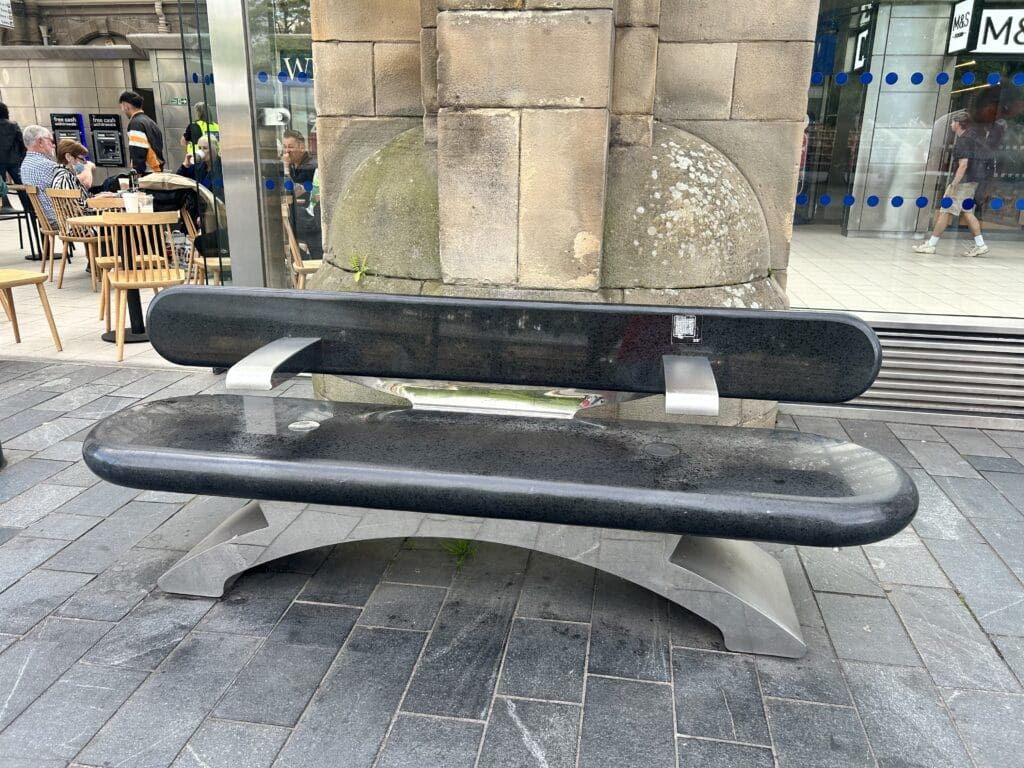
Armrests on benches are designed to prevent people laying down for long.
ALSO READ: Homelessness risk rises for households leaving asylum accommodation
Q. What kind of message do you think seeing architecture like that gives to people who are just trying to exist in society?
“I suppose it’s how much people notice the architecture until they have to use it for a particular reason. There are major issues about how we allow spaces for groups who are deemed antisocial or difficult to congregate, and I think that has an interesting class dimension. I live near a park in a relatively affluent context; when it’s sunny, it’s full of young people congregating, and by and large, policing isn’t an issue. In a park in a different socioeconomic context, that same congregation of people having barbecues and drinking might be policed, managed, and designed in different ways because it’s seen as more of a problem or something that needs more management.
We get controlled in all kinds of ways by the overlap between policing and planning, which leads to the redesign of places. Probably the biggest tool in the armoury of controlling public spaces is surveillance, CCTV. That’s linked to predictive and anticipatory policing practices, which favour and allow the police to intervene and monitor a group of people they deem unwanted.
Q. Do you think that local communities have the power to fight back against this type of design, or do you think the public sector is just looking to minimize the visibility of it?
“I think people are aware of homelessness, but there’s an assumption that somebody is providing services somewhere and these things get picked up. I’m not sure how much awareness there is of just how little provision there is. There have been strategies which minimize the visibility of homelessness and the issues that it causes. There is a history – and it’s not just a recent history – that rough sleeping has been pushed to the margins and made less visible. Hostile architecture is part of making sure it is less visible so that people aren’t congregating around doorways, people aren’t sleeping on benches in city centres, and we’re not having to confront homelessness on a day-to-day basis.”
Q. What would be your ideal situation when addressing these issues and this type of architecture?
“Government needs a strategy with funding to work out what to do about rough sleeping. Until we have that sort of openness – an explicit strategy – you can’t really engage the debate. I can see why the choices around public realm architecture happen, and I can see why that’s become part of public policy. But the broader issue sits beyond that. It is about what the strategy is for rough sleepers and homelessness, and finding the appropriate strands to deal with it, including making space in the public realm to be able to provide appropriate facilities.”
To know more about Professor While’s work, click the link here.