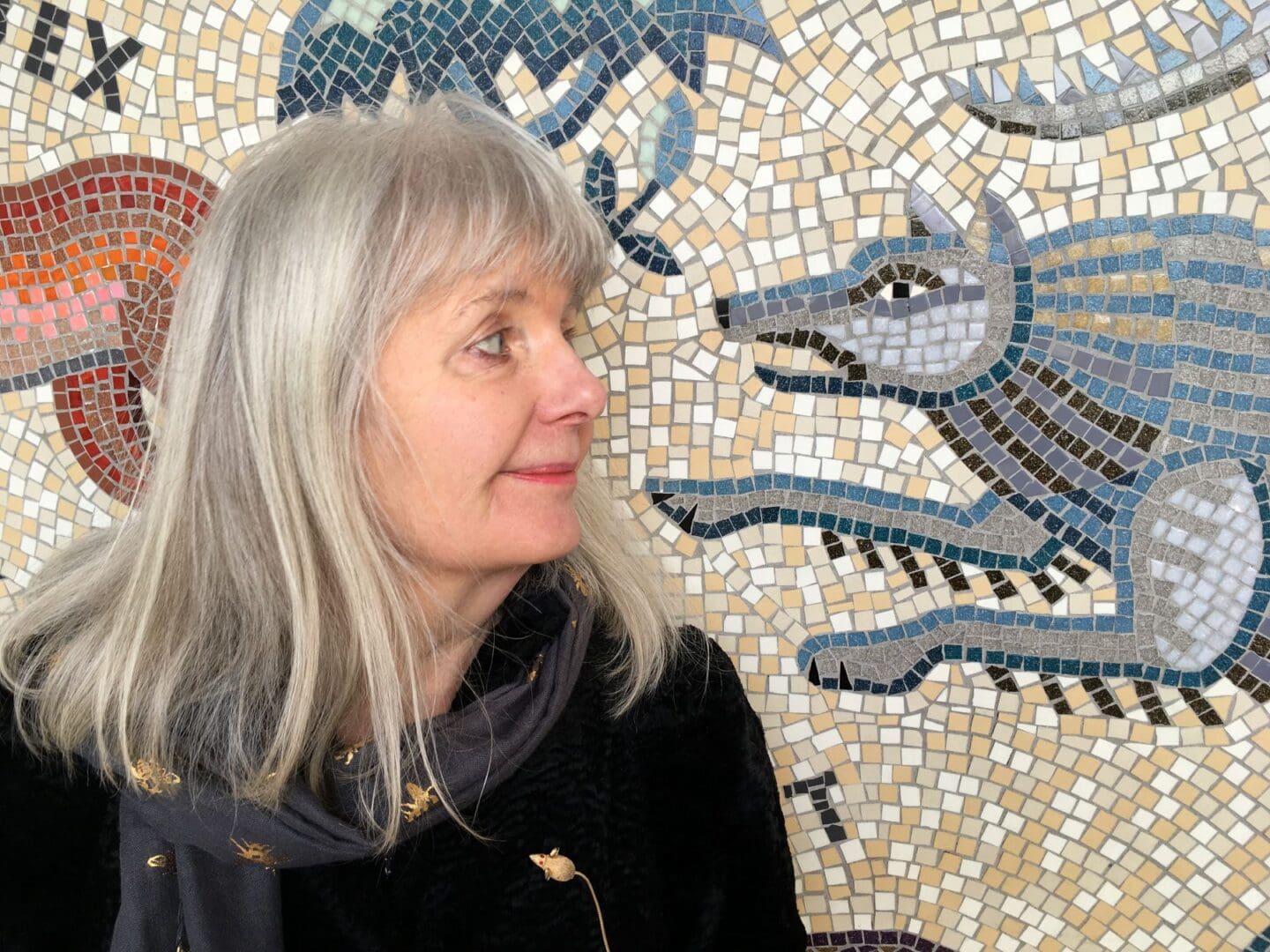
Photo: Tessa Hunkin
At a community mosaic project in Hackney, volunteers rebuilding their lives through art now face an uncertain future as plans to repurpose their space threaten the support network they’ve come to rely on.
Among fragments of coloured tile and half-finished mugs of tea, volunteers sit shoulder to shoulder inside the Pavilion at Hackney Downs. One of them is Gaynor.
She came to the Hackney Mosaic Project following a diagnosis of a long-term health condition, looking for something that might help quieten the constant cycle of overthinking that accompanied it.
Now, as she carefully places fragments of coloured tile into a growing mosaic, the steady snap of tile cutters fills the room around her.
Across the tables, goats, birds and patterned borders slowly take shape. People from different backgrounds work side by side, focused less on talking and more on the careful placement of each shard.
Moving between the tables, founder Tessa Hunkin offers quiet guidance, adjusting a line here, suggesting a colour there, before stepping back to let the work continue.
The Pavilion, once built as changing rooms for the surrounding park, has become something else entirely. On Wednesdays and Fridays, and alternate Saturdays, it fills with volunteers recruited from Hackney recovery services and the local community.
Tessa describes the process as “a holiday from your head”, absorbing enough to block out everything else without becoming overwhelming.
She is clear that bringing people together is not always seamless.
“The human mosaic is definitely quite chaotic,” she says.
“But the thing that we’re actually making is this small area of order and calm, and the rules are quite simple, and the chaos can be controlled.”
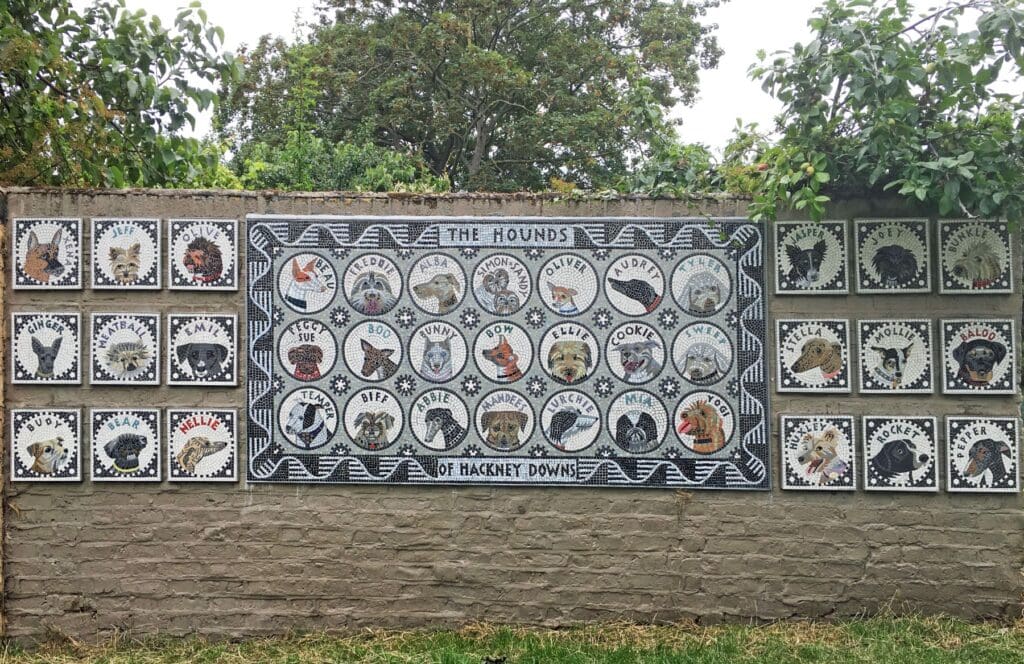
The hounds of the Hackney Downs | Photo: Tessa Hunkin
Building Community Through Mosaic
Founded in 2011, the Hackney Mosaic Project brings together volunteers from Hackney recovery services and the wider community to create large-scale mosaic artworks across the borough.
Using fragments of ceramic tile, stone and glass, the group designs and installs colourful panels in parks, estates and public spaces.
They also make their own personal pieces to take home with them or sell to fund the project.
Its founder, Tessa Hunkin, is an architect turned mosaicist who discovered the value of doing something physical for good mental health.
She was drawn to mosaic because it combines creativity with repetition, allowing people to contribute to a larger piece without needing previous artistic experience.
She points to the use of basket weaving and other crafts as occupational therapy for soldiers experiencing shell shock after the First World War.
“If I make something, I feel better. I’m sort of grounded, just concentrating on something else,” she says.
“I’d often wondered whether this would be true for other people. It was an old idea of occupational therapy.”
This philosophy runs through the Hackney Mosaic Project. The attendees are not defined by what they have been through but brought together through the medium of mosaic art.
“One of the things I really liked about it was that it helped people define themselves, not by their problem but by the activity that we all do together,” she says.
“You’re suffering from your own problem. But then maybe you meet somebody who’s physically disabled, and it enlarges your understanding of how other people can manage, that other people have different kinds of problems, and you’re not alone.”
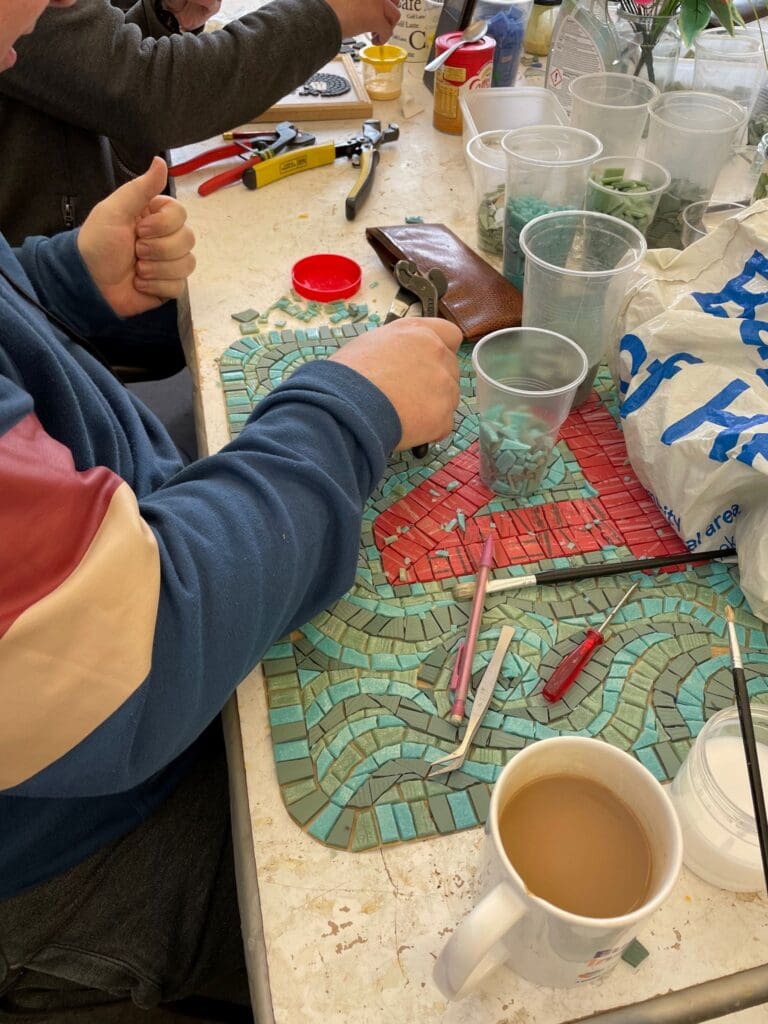
Volunteers hard at work | Photo: Tessa Hunkin
Why Mosaic Works
Part of the appeal of mosaic is the slow physical process of making it.
Unlike many modern hobbies, it requires patience, repetition and careful attention to small details.
As work and entertainment become increasingly digital, Tessa believes the act of making something by hand has become more valuable for many people seeking focus or recovery.
Research into art therapy and creative activity consistently shows benefits for mental health. A review of art therapy studies by researchers at University College London found that creative activities such as visual art and craft can significantly improve emotional well-being and reduce anxiety.
For Tessa, the appeal lies in the balance between concentration and simplicity.
“It’s not too challenging, but it requires just enough concentration to block off all the other things that are going through your head.”
For some of the people involved in the project, that small area of “order and calm” has helped bring structure to other parts of their lives as well.
A Different Kind of Recovery
Ken Edwards has been part of the Hackney Mosaic Project for more than a decade.
Now 61, he helps install the mosaics across the borough and serves as the group’s secretary, welcoming new volunteers to the sessions at Hackney Downs.
When he first arrived fourteen years ago, while struggling with alcoholism, art was not something he expected to enjoy.
“I’ve never had any form of training in art,” he says. “I’ve never liked it. I’ve never liked looking at it, I’ve never liked doing it.”
However, from that first session, despite being sceptical, he was transfixed.
“From that moment, I was hooked. Once I started doing it, I just kept coming back.”
The sessions quickly became a refuge for him, offering a way to focus on something outside the pressures of everyday life.
“When you’re sitting there, and you’re doing the mosaics, you don’t think about anything that’s going on in your life,” he says.
“You don’t think of the electric bills coming, or that you haven’t got enough food. You’re not scared, you’re happy, you’re having a laugh and you’re with like-minded people.”
Over time, Ken’s interest in mosaic grew into a passion.
His work has since appeared in projects across the world, including Cyprus, Spain and the United States.
Among the pieces he is most proud of is a portrait of Queen Cleopatra, created from hundreds of carefully arranged fragments.
The piece meant too much to him to sell, and now hangs on the wall of his home.
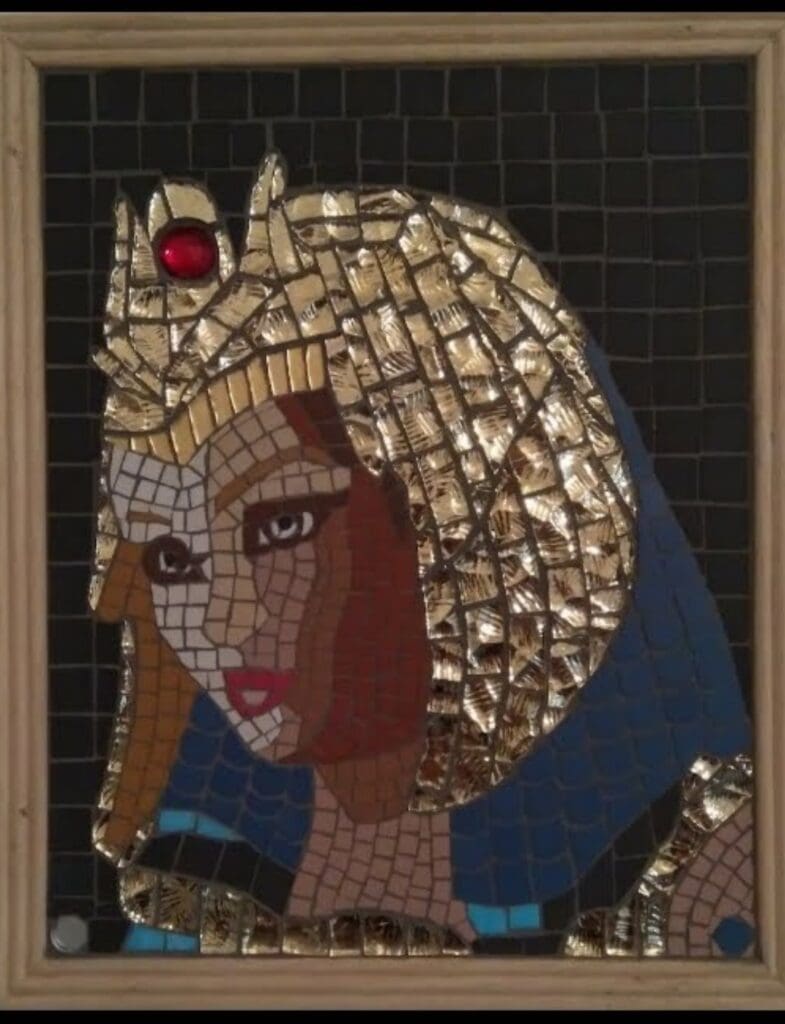
Ken’s portrait of Cleopatra | Photo: Tessa Hunkin
A Space to Focus
Ken’s journey is echoed across the room, where many arrive unsure of what they might gain, and leave with far more than they expected.
Gaynor is one of them.
She came to the project following a diagnosis of a long-term health condition, looking for something that might help quieten the constant cycle of overthinking.
“It just helps me not to focus so much on my health conditions, and it just keeps me in a flow,” she says.
It is less of a fascination with mosaic and more of a way to occupy her hands and mind for Gaynor.
“You don’t really have time to think,” she says.
That focus is only part of the appeal. The project also allows people to exist outside of what they may be dealing with.
“I just don’t want that to define me,” she says.
Although many who attend the sessions have faced different challenges, there is no pressure to share personal circumstances.
Instead, the emphasis remains on the work itself, allowing people to connect through what they are making rather than what they have been through.
That sense of focus carries into the pieces themselves.
One of Gaynor’s favourite works began as a photograph she took on a walk with her son.
“I took a photograph of a magpie and turned that into a mosaic,” she says.
Alongside individual pieces, much of the work is collaborative, with volunteers each contributing to larger installations across Hackney and beyond.
“We all do a little piece of a bigger mosaic, and then it all comes together,” she says.
For Gaynor, that shared process is what sets the project apart. “It is a proper community.”
That sense of community extends beyond the mosaics themselves.
For many volunteers, the Pavilion has become a reliable place to return to each week.
Somewhere that offers routine, friendship and purpose.
It is those qualities that now feel at risk.
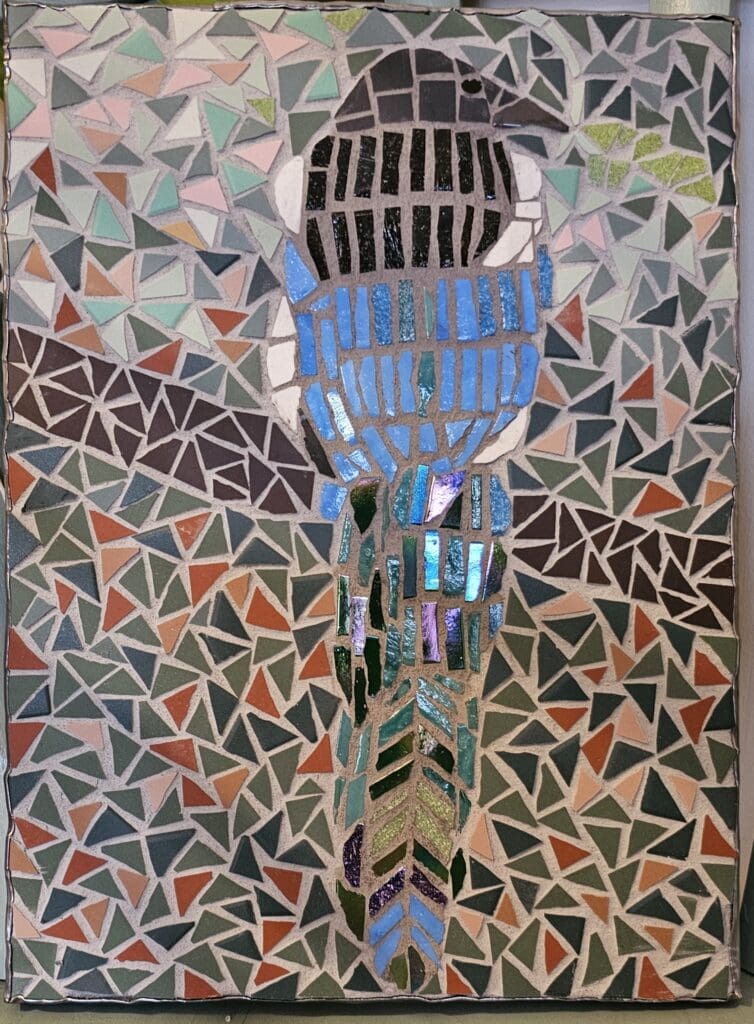
Gaynor’s magpie | Photo: Tessa Hunkin
A Community Under Threat
However, the future of the Hackney Mosaic Project now faces uncertainty.
The Pavilion is set to be repurposed by the council into a café.
That sense of escape is now accompanied by growing frustration about what could be lost.
Councillor Jacob Cable, Cabinet Member for Climate, Clean Air, Energy and Transport at Hackney Council, said:
“Last year the Council asked for feedback on its proposals to transform the currently underused Hackney Downs Pavilion into a new cafe and flexible community space. Overall sentiment was strongly supportive of the project and we are currently considering the feedback, and if any changes need to be made to the designs, in response to this.
“The proposals include a space that community groups and residents can hire for a variety of purposes. This opportunity to hire the space will also be open to the Hackney Mosaic Project, which currently rents space in the Pavilion for around six to nine hours a week.
“We will carry on working closely with the Hackney Mosaic Project.”
For Gaynor, the issue is not just about space, but about the disruption of something already working: “I think councils are very good at saying, we’re going to create a community at the expense of a community that is already there,” she says.
That concern is shared across the group.
“It would be a disgrace if they chucked us out of here,” says Ken, who has been part of the project for over a decade.
For him, the Pavilion is more than a workspace. Its accessibility and familiarity make it a place people can reliably return to for support.
Tessa sees the building as integral to how the work itself comes together.
“It makes a huge difference if you’re working on a big scale, everybody can see how their work fits in with everybody else’s work,” she says.
While she recognises the council’s need to generate income from the site, she believes the space could still accommodate both a café and the project.
Together, their perspectives point to a shared tension and uncertainty which takes away from the respite that the Hackney Mosaic Project consistently gives them.
Back inside the Pavilion, the steady rhythm of tile cutters continues. Around the tables, fragments of colour are shaped and placed with care, each piece gradually finding its place within a larger design.
For now, little has changed. Volunteers still arrive, take their seats, and lose themselves in the slow, methodical process of making.
Conversations drift between concentration and laughter, cups of tea sit half-finished beside works in progress, and the room fills with the quiet focus that has come to define the project.
It is this consistency that underpins what the Hackney Mosaic Project offers. Not a solution, but a space. Not a cure, but a form of relief.
Whether that continues in this building remains uncertain.
But for those gathered around the tables, placing one piece at a time, the value of what has been built here is already clear, something carefully assembled, fragile in places, but held together by the people who return to it week after week.
Read more about our Save Our Spaces Campaign here: