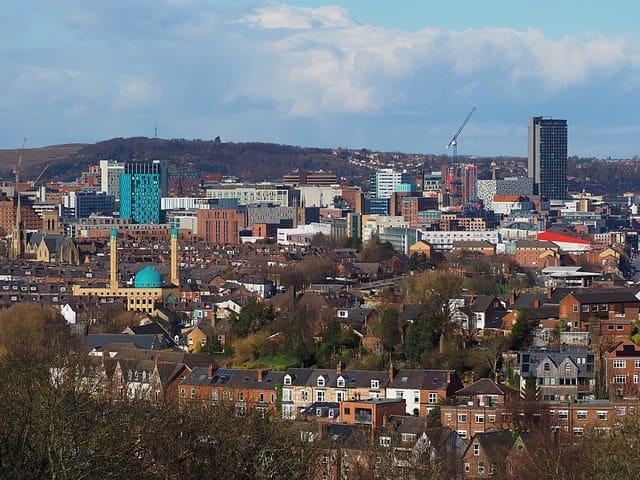
Photo: by Graham Hogg
For a city with hundreds of community venues, Sheffield can feel surprisingly unequal depending on where you live.
As part of our Community Space series, Sheffield is the first that we will break down to understand the scope of its community spaces.
In some parts of the city, residents are within walking distance of libraries, youth clubs, recovery groups, arts hubs and community cafés. In others, the nearest publicly accessible space may be over a mile away, operate on reduced hours, or rely almost entirely on volunteers.
As councils across the UK continue to face financial pressure, Uproute is now pushing for a legal “Community Space Access Standard” that would require every resident to have access to a free or low-cost community space within a 15-minute walk of their home, or via accessible public transport.
The proposal would place a legal duty on councils to assess provision, protect existing facilities and replace spaces lost to redevelopment.
In Sheffield, the debate raises a difficult question.
Could every resident currently reach a community space in 15 minutes?
The city centre advantage
For residents living in and around Sheffield city centre, access to community infrastructure is relatively strong.
Areas such as Broomhall, Sharrow, Kelham Island and the city centre itself are surrounded by publicly accessible venues including:
- Sheffield Central Library
- The Circle
- Sadacca
- Showroom Workstation
- Broomhall Centre
Many of these spaces host support groups, creative workshops, youth activities, wellbeing sessions and community events throughout the week.
For students and young professionals living in inner Sheffield, multiple community venues are often reachable within ten minutes on foot.
But the picture changes further away from the centre.
The outer-estate gap
In parts of Parson Cross, Shiregreen, Manor, Batemoor and Arbourthorne, access becomes far more limited.
Community spaces still exist in these areas and many play a vital role locally. Organisations such as:
- Longley 4Greens Community Centre
- Manor and Castle Development Trust
- Jordanthorpe and Batemoor Community Centre
- The Sanctuary
provide food support, youth work, employability services, mental health activities and social groups.
However, provision is often more spread out than in central areas.
Some residential streets sit over a mile from the nearest major indoor community venue, meaning residents may rely on buses or long walking routes to reach support services.
That can create barriers for:
- elderly residents
- disabled people
- people without access to transport
- parents with young children
- those experiencing mental health difficulties
While Sheffield technically still has community infrastructure, accessibility is uneven across the city.
South-west Sheffield: A different kind of access
In wealthier areas such as Dore, Totley, Fulwood and Ecclesall, community spaces are generally easier to find.
Church halls, parish centres, scout huts and local libraries are spread throughout these neighbourhoods, including:
- Christ Church Dore Community Centre
- Totley Library
- Fulwood Old Chapel
- Ecclesall Parish Hall
But these areas expose another issue within the wider debate.
What actually counts as an accessible community space?
Many venues in south-west Sheffield are church-operated, privately managed, or only open at specific times for organised groups and bookings.
Critics argue that simply having buildings nearby does not automatically guarantee meaningful public access.
A church hall used twice a week is very different to a staffed community hub operating daily with open support services.
A national decline reflected locally
The questions being raised in Sheffield mirror a wider national trend.
Across England, more than 1,000 youth centres have closed since 2010, while youth service funding has fallen dramatically.
Libraries have also faced major cuts, with around 800 public libraries closing nationally since 2010.
Many remaining spaces now operate with:
- reduced opening hours
- volunteer staffing
- reduced activity programmes
- limited outreach work
In Sheffield, this often appears less as outright closure and more as gradual reduction.
Buildings remain open, but the level of support available inside them slowly shrinks.
Why community spaces matter
At Uproute we believe these spaces should be treated as essential social infrastructure rather than optional extras.
Community spaces are increasingly relied upon for:
- addiction recovery meetings
- food support
- youth activities
- social prescribing
- mental health support
- tackling loneliness
- arts and wellbeing programmes
The NHS itself now promotes social prescribing, connecting patients with local activities and support groups to improve wellbeing outside traditional medical settings.
But those initiatives rely on infrastructure that is steadily disappearing.
Many patients are signposted by the NHS to these community centres for specialised help meaning that that may not be possible for much longer or as often if these spaces are less available.
The closure of a library or youth centre does not simply remove a building.
It removes somewhere warm to sit during winter. Somewhere to meet people. Somewhere to ask for help. Somewhere to feel less alone.
So, could Sheffield meet a 15-minute standard?
In some neighbourhoods, yes.
In others, access is inconsistent, fragmented or dependent on limited opening times.
That is why Uproute is pushing for access to community spaces to become a legal requirement rather than planning guidance alone.
Because while Sheffield still has hundreds of community venues, where you live continues to shape what support and connection you can realistically access.
And for many people, that distance matters more than ever.
Read more about our campaign here: