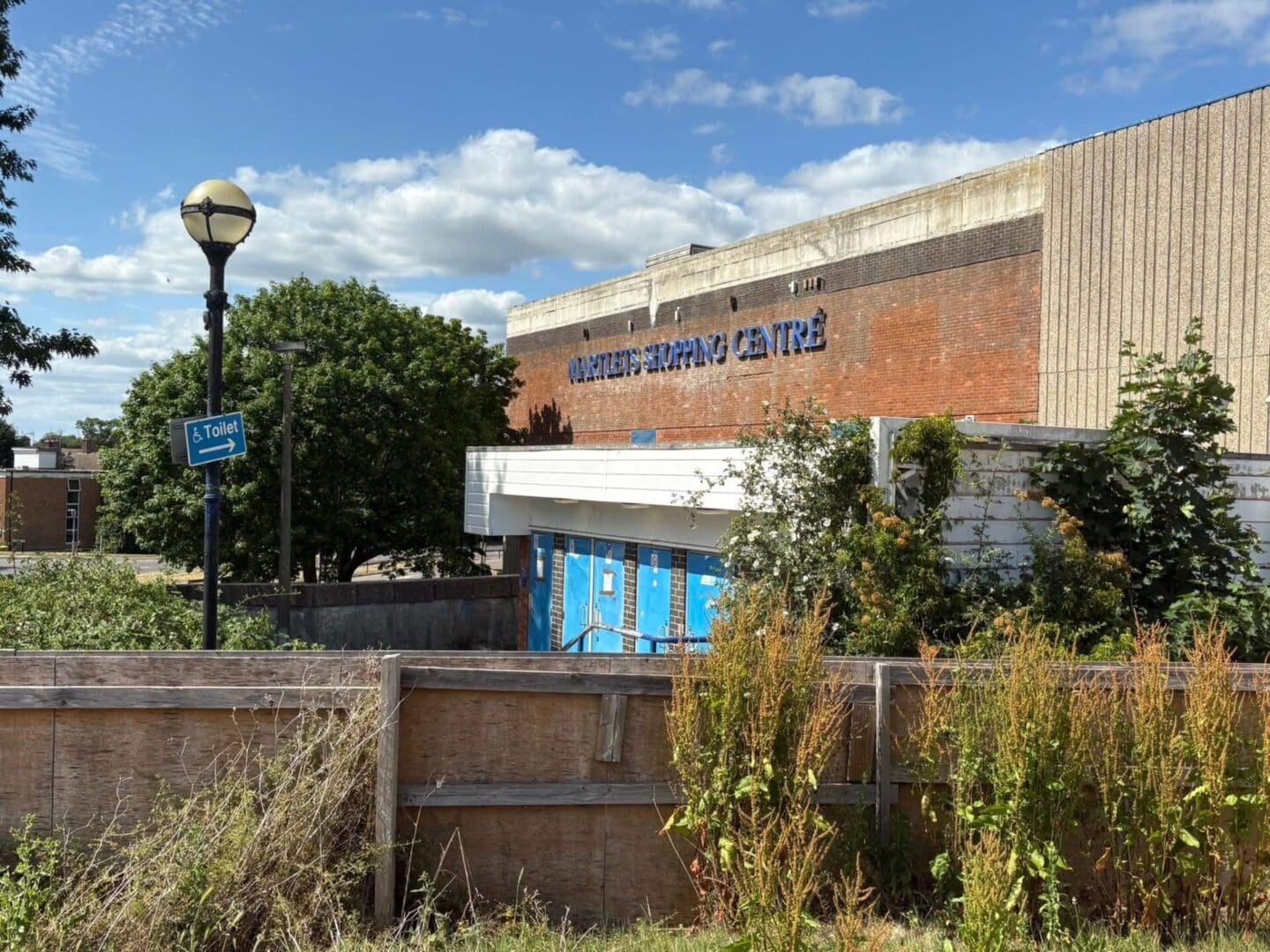
Would you use these toilets? Image of public toilets in the town of Burgess Hill
The provision of public toilets has gone down the drain in towns across the UK, leaving us with the question how can anything improve if we cant get the basic necessities?
The UK is estimated to have lost approximately 50% of its public toilets over the last decade, according to The British Toilet Association.
But why is this such a big deal? Surely you can just sneak into a bar and use their bathroom hoping nobody will notice.
Maybe for the average person this is the case, but the issue goes much deeper, affecting disabled people and people who have health conditions, as well as other groups that rely on public toilets. Overall, it is about a decline of public facilities over the past few years and a lack of support for the community.
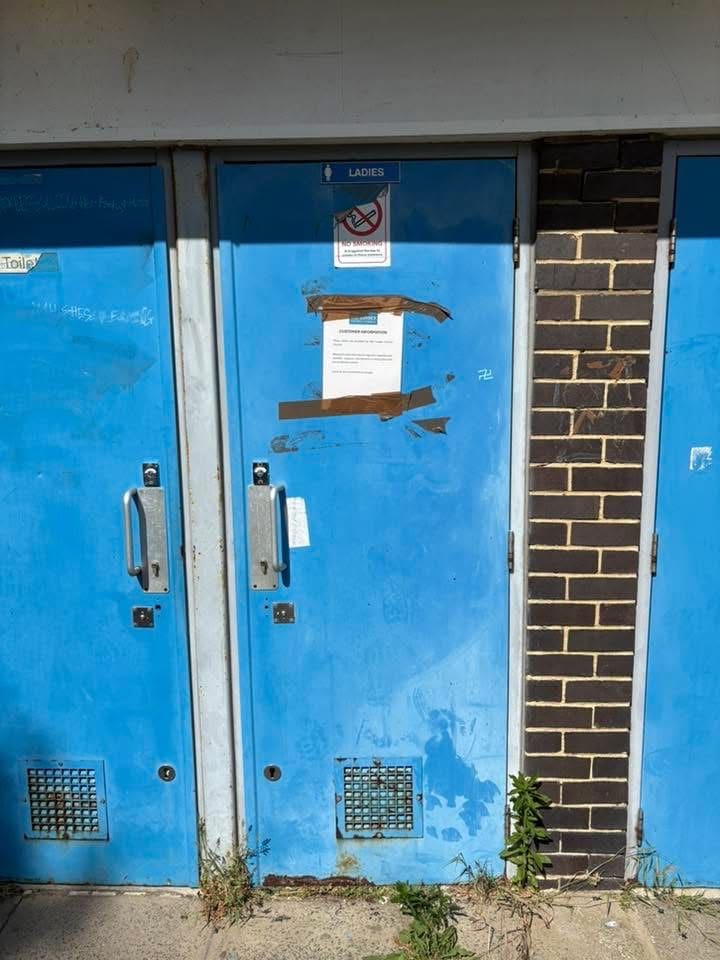
One of the public toilets in the centre of Burgess Hill
So why is this happening?
This issue was playing on my mind and unlike most people, I couldn’t hold it in, so I spoke to Raymond Martin, the managing director of the British Toilet Association to understand why the provision of public toilets is in decline.
“There is no statutory duty for local councils to provide public toilets which means budgets are spent on welfare, social issues, parks cemeteries, and things like toilets take a hammering when money is tight.
“But going to the toilet is crucial to our everyday existence and there should be provision for them.”
It seems to be a problem affecting especially smaller towns where council money is spread thin.
In Wednesfield, Wolverhampton public toilets were shut down at a Retail Park after being vandalised, a common reason for why many toilets are shut down.
Phil Bateman MBE, Councillor for Wednesfield North said: “The public have made their views known and there is a clear expectation that high-quality, accessible toilet facilities should be part of a major retail destination.
“I know how important these facilities are for disabled residents, carers, and families who rely on public toilets when out on shopping trips.
“The Local Authority and the Police are now operating a new plan to reduce Anti-social Behaviour (ASB).”
Who is being affected?
However other towns such as Burgess Hill have become extremely inaccessible for residents. With a lack of willingness from the council to put funding into toilets that are likely to be vandalised soon after.
I posted on a local Facebook page to ask residents about their experiences and the majority of commenters were upset with the lack of toilets or upkeep of existing ones.
Natasha Penney, from Burgess Hill said her young son, who had cancer in his bladder, requires access to the toilet often, and due to nerve damage doesn’t have much warning prior.
“It is really hard for us, and is basically down to the public to respect the toilets and unfortunately people don’t understand the actual need for them so this isn’t the case and they usually get closed down,” she says.
Bladder and Bowel is a UK wide service dedicated to supporting individuals with bladder and bowel control problems. The Managing Director, Jo Umbers said: “For those living with a bladder or bowel condition, leaving the house has become even more difficult.
In response to this they developed the ‘The Just Can’t Wait card’ which enables people to discreetly communicate their urgent need to use a toilet to local venues, and get help when they need it.
“In turn we hear from people who use our toilet card that they feel more confident getting out and about, and better supported with their condition.”
“We recognise the continued value of public facilities in town centres; however, we hope our councils will continue to support the most vulnerable in our communities.”
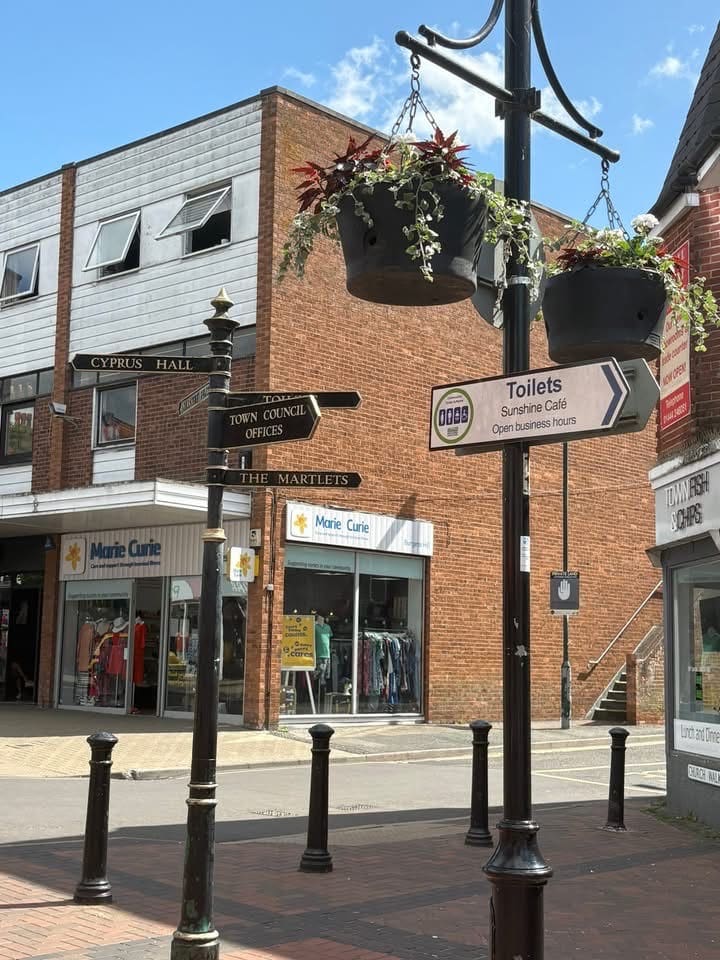
Sign pointing to Sunshine Cafe as an available toilet to use
Mid Sussex District Council has made some moves to improve the access to toilets in the town, by implementing a community toilet scheme which gives funding to local businesses to open their toilets to the public without needing to buy anything.
However, another resident who commented on the post I created told me she was refused access by Sunshine Cafe, one of the businesses that is a part of the scheme.
“I have a condition which gives me the urge to urinate more frequently, but they didn’t let me use the toilet.
“Maybe the staff member was having a bad day but this policy should be clarified and advertised more widely,” she says.
Uproute approached Sunshine Cafe for comment but was unable to reach them.
Guy Harwood, long time resident of Burgess Hill suffers from multiple sclerosis (MS) and due to medication he takes to manage his MS needs to urinate more frequently.
“I’ve lived in Burgess Hill, growing up, public toilets were always available but now we can’t rely on public infrastructure. I always have to be very mindful of where I could rush to as quickly as possible, and nowadays I have to discount the public toilets because they’re either never open or totally wrecked,” he says.
Mr Harwood says he no longer goes to Burgess Hill town centre for that reason.
I asked Mr Harwood how he felt about asking local establishments to use their facilities instead.
“Of course it’s very different being disabled and asking versus being able bodied and asking but the other thing is if you just looked at me you wouldn’t be able to tell I have a disability because MS is an invisible disability.”
Mr Harwood says it is less common that people would assume he doesn’t have a disability as most disabled people have a radar key – specifically designed key that opens over 9,000 disabled toilets across the UK.
However, he went on to say that anyone can purchase a radar key online and this is not a solution to stopping vandalism and anti-social behaviour alone.
Fazilet Hadi, our Head of Policy at Disability UK said: “Without public toilets, millions of Disabled people are prevented from getting out and about and are by default socially excluded. Providing sufficient accessible toilets is not an optional add-on, it is a legal obligation under the Equality Act.”
Disability UK also shed light on a more recent issue to do with the Equalities and Human Rights Commission (EHRC) guidance which now approved by ministers makes it clear that transgender people should be offered a third or gender neutral space.
This is because according to new guidance single sex spaces such as changing rooms and toilets must be used on the basis of biological sex.
Mr Hadi from Disability UK said: “Given the scarcity of accessible toilets, it is astonishing that the body allegedly responsible for upholding equality has produced guidance that essentially excludes trans people from using public facilities whilst offering accessible toilets as a loophole.
“This pits trans people and Disabled people, who both experience deep exclusion, against each other. However, our struggles are very much interlinked. Be that through medical gatekeeping or fearing we will not be able to use a bathroom, either as a result of inaccessibility or worry around harassment.
“Trans people should have the right to use public facilities without facing harassment or violence. Disabled people should not be fearing a lack of accessible facilities.
“When society is made more accessible, all of us win.”
So, what can be done?
Changing Places Toilets (CPT) is a business that has emerged in response to the decline in accessible public toilets.
CPT said: “Changing Places toilets are essential because they are specifically designed to meet more complex needs. With features such as a height-adjustable bench, full-room coverage ceiling-track hoist, peninsular toilet, and sufficient space for carers, they provide a safe, dignified, and practical solution that standard accessible toilets cannot offer.
“While reduced provision of standard public toilets affects the wider population, CPT users are disproportionately impacted because their needs cannot be met by typical accessible toilets. For individuals who require additional space, specialist equipment, and support from carers, the lack of Changing Places toilets can make leaving home extremely difficult or, in some cases, impossible.
“Expanding the availability of Changing Places toilets is therefore critical. It not only addresses the longstanding shortage experienced by CPT users but also ensures that disabled people have equitable access to public spaces and opportunities to participate fully in society.”
Raymond Martin, the managing director of the British Toilet Association spoke with me about a few more solutions that could be implemented to improve this issue.
- Cut from local authority budgets
Ring-fencing funding specifically for these facilities.
- National standards or legislation
Introducing minimum requirements for towns, cities, and transport hubs would create accountability and clear guidelines.
- Community toilet schemes
As mentioned above the scheme will pay cafes pubs and shops a small fee to allow the public to use their toilets
- Charging on the doors
Although this can make toilets less accessible for people who cant afford to pay it can help maintain upkeep
- A hybrid model in which a business is half a shop and half a toilet
The revenue from the retail side pays for the upkeep of the facility
Additionally, local councils need to look at what more can be done to counter anti-social behaviour and vandalism.
At the end of the day sh*t needs to change, more attention should be brought to the issue of public toilets, something that is often overlooked but is a daily barrier for many people.
If you want to read more stories that focus on local issues you can read: