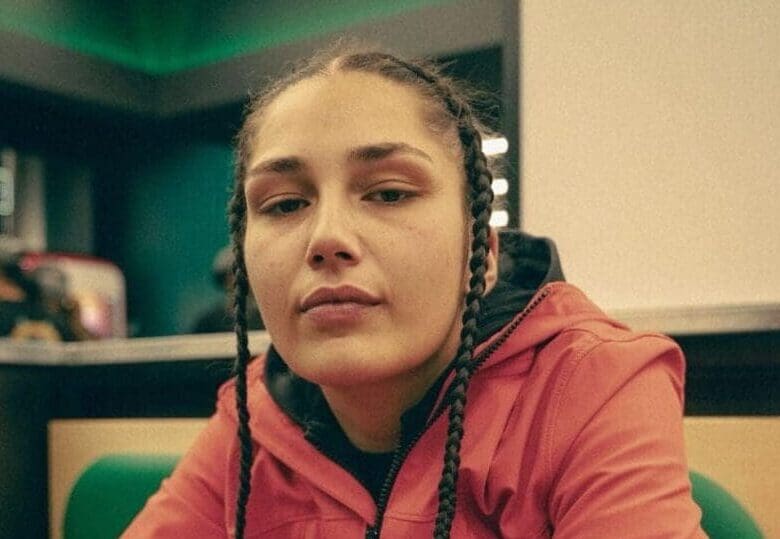
Photo: Amy J Sherwin (AJ)
The sun beams through the window as rapper Amy J Sherwin calms her dog, who has every right to be riled up. It’s been a long time since he’s seen her (a whole weekend), but for his guardian, it’s been a weekend of big milestones.
“I just turned 26 over the weekend, that’s why I was in London as well, celebrating with my girlfriend’s family. Also dropped a track with Toddla T which has been popping off, things are just moving mad,” says Sherwin, smiling in a daze as if it’s all still a dream.
Through her collaborations with the legendary Sheffield producer, AJ (Sherwin’s rap moniker) has entered into a new realm of her artistry over the last year. With their first track 3P reaching millions of people in October 2025, she’s been on a whirlwind journey that’s seen her take centre stage across the UK and even in the US. For the Sheffield born and bred rapper, her current trajectory is only natural as she recalls her earliest memories of rapping.
She says, “I always wanted to be a rapper. Always. When I was younger, I’d stand on my bed and pretend that the floor under my bed was full of people, like I was in a stadium. I feel like I always knew subconsciously, but because of the way I was and what I came from, it didn’t seem possible at that time to see it as an actual career.”
Growing up in the Firth Park ward of Sheffield, AJ’s childhood was filled with social workers and therapists filtering in and out of her home, her first experience with the care system. The last time AJ ever saw her mother was when she was six, leading her to live with her great-aunt and uncle. Her usual swagger fades and she goes quiet, remembering the frustrating times in the household.
“Me and my great-aunt didn’t get along at all. There were a lot of fights, a lot of screaming and I was treated so differently from her son. I remember being grounded for a whole six weeks of holiday one time. It just made me question why she’d even take me in if she felt a certain way about me,” she says.
The only thing that offered solace to AJ was rap. Listening to pioneers like Tupac, she started penning down her thoughts and feelings about the world, which eventually converted from journaling to poetry writing. Sharing her verses with her peers was tucked far away in her mind at this point, as the disruptive environment at home took centre stage in her life, converting to a deep anger that she carried everywhere she went, especially in school.
Waving her tattooed hands around, she says “All my teachers used to say that if I put my head down, I’d crack the code. But I couldn’t leave my distractions at the door. I had a few good people but I used to always get sent home for fighting. I used to have mad bruises on my face, plasters all over and eventually, I got kicked out.
With her suspension and the frustrations at home, the walls started to close in on AJ, and at the age of 15, she reached her breaking point. She made a bold decision to leave her house, but after some time, decided to return. Instead of an open door, she met a family reluctant to take her back. With no other choice, AJ went back into the care system, which began her journey all over Sheffield, going from care home to care home. With a fleeting sense of belonging and lackluster support from the system, her teenage years were defined by identity issues.
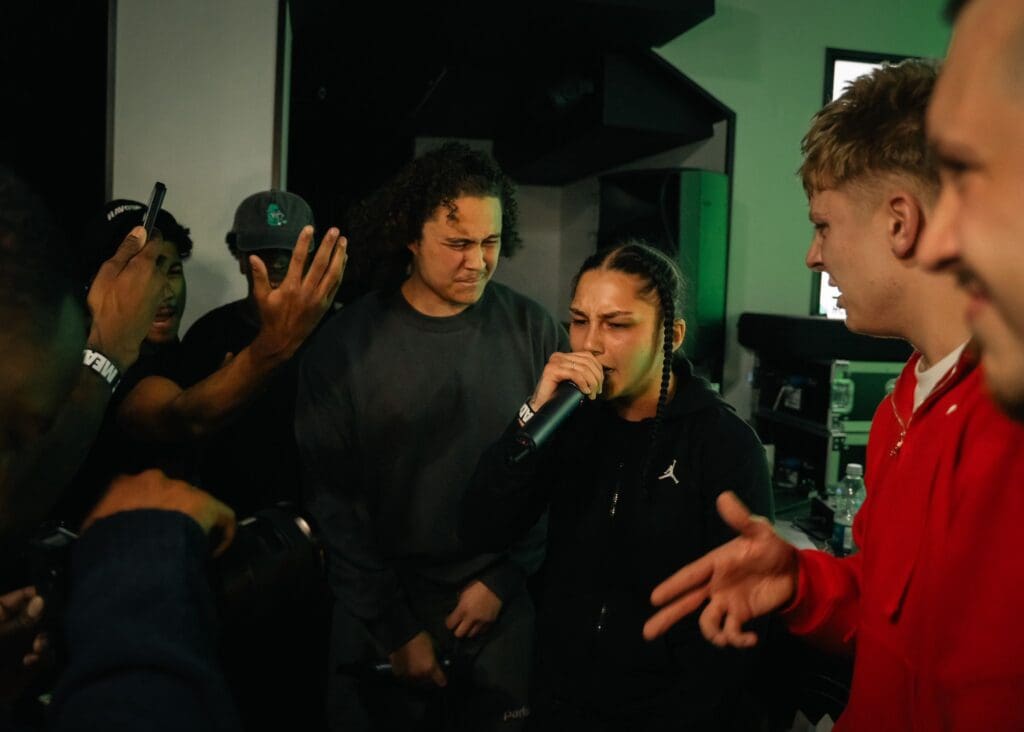
“It was the people I was around that pushed me to take control of my life and shape it the way I want it to be,” says AJ.
She explains, “Moving about at first, I feel like I had a very heavy heart because I just thought, why can’t I just be in one place and be all right? It was this daunting feeling that I couldn’t get rid of. To the system, I was just another number. They had me in the wrong speaking therapy thinking I was trying to hurt myself, but all I needed was to explain my demons. It took me so long to understand why I am the way I am because I had to do it all alone.”
Finally at 18, with her own flat, her dog and a strong-willed facade that she had to unwillingly build up to survive, AJ got to work. Doing odd jobs in the city for Sheffield Council, devoid of proper qualifications, what seemed like a new beginning soon became a dead-end struggle to stay afloat, having a major impact on her mental health. She slowly started going back to the one thing that was always there for her.
“There were a lot of times then where I struggled with where I wanted to be because if I couldn’t get that down on a piece of paper, I didn’t want to be here all together. In the end, it was the people I was around that pushed me to take control of my life and shape it the way I want it to be,” she says.
Those same people, who had watched her at her worst, would soon be the first to be caught off guard by what came next. Going back to her passions, she started attending a regular music workshop by Sheffield charity Element Society where she met Dominic Heslop, who runs Slambarz, an organisation supporting young rap artists. Too shy to share her poems with everyone else in the group, it took her a studio session to really let loose and for Dom to find his next star.
ALSO READ: Shocka: author of his history
“It was this little boo studio but I felt good in there and I just started spitting. Dom gassed me up because it came from pain, I was speaking the truth. From there, he stuck with me ever since. We were getting in touch with people, he was pushing me to the next show, he stayed on me and didn’t let up.”
However, she almost gave up as soon as things started to pick up due to the loss of her grandmother, who was a big inspiration to AJ. Having lost her just a few days before one of her earliest shows, the rapper flopped her bars in front of a sell-out crowd. Overcome with fear and embarrassment, she almost went off stage until the crowd cheered her back on. It was this moment and the subsequent interaction with a Sheffield legend that affirmed her path.
She says giddily, “I’d just got off stage at a Slambarz event. Coco was one of the judges, I used to watch him growing up along with Toddla. He came up to me and he was like, “Your time is now, you’re ready.” To hear that from somebody that I admired growing up and took a lot from, it was just mad. I thought I’d made it.”
Error: No feed found.
Please go to the Instagram Feed settings page to create a feed.
Grabbing this validation with both hands like her mic on stage, AJ quickly started her climb to the top of Sheffield’s rap scene, winning competitions which earned her studio time, connections with top producers and more importantly, helped her find her purpose. Music didn’t just give her an escape from a lifetime of pain, it gave her a means to understand it and make real change in her community, a home where she’s always felt wanted.
Looking outside her window, she says, “I’d only lash out at people earlier because I was insecure. Music definitely gave me that confidence in terms of who I’ve always meant to be. From having the stage on my bed to being on a real life stage and having kids come up to me afterwards, telling me they can relate, it’s a pretty good feeling.”
AJ’s mission with her music is more than just a personal rebranding of her life. Through her voice, she wants to reach communities internationally, becoming a beacon of hope for a world that seems to be always in conflict. Shifting in her seat as if she’s getting ready to lay her verses in a studio, she shares her hopes and dreams with a serious tone.
“For as long as I’m breathing, I’m always going to be that advocate for people, whether they are grieving, hurting or going through loss. Now that I’m getting a lot of attention, all I think about is how I can give back to the people. I want my music to give strength to those unheard, making someone relate to my words is what real success looks like to me.”
To know more about AJ’s story and music, follow her on Instagram.